Pile o’ Magic Commander
Local rules · Commander version of Pile o’ Magic
The shared-library game with 40 life and a commander for each player. All normal Magic and Commander rules apply except where this page changes them. The rules here are complete; you do not need the ordinary Pile o’ Magic page as well. The two versions differ in starting life, copy limit, and commanders.
Setup
- Build a Messy Pile or a Themed Pile, as described below, and shuffle it. It replaces the separate 100-card decks of normal Commander.
- Set out the Heap Lands, or agree on a land area and markers.
- Choose commanders using one of the three selection methods. Agree on the method before play.
- Each player starts at 40 life, puts their commander in their command zone, and draws seven cards from the Pile.
Take normal individual turns. The Pile ignores color identity: its cards do not have to match anyone's commander. Otherwise commanders behave normally, including command-zone movement, commander tax, and losing to 21 combat damage from a single commander.
Copy limit: singleton
The Pile holds one copy of each card name. Basic lands and cards that allow any number of copies are exempt. This replaces the Singlesome limit of ordinary Pile o’ Magic.
The Pile
All players draw from one shared library, called the Pile. Build it in one of two ways:
- Messy Pile: every player brings 45 or more cards of their own and shuffles them into the Pile.
- Themed Pile: a host or the group builds the Pile in advance around a theme, a Magic set, a mechanical archetype, or similar.
The traditional size for maximum madness is about 300 cards. A Themed Pile may play better with a smaller pool. The minimum Pile size is 45 cards per player.
Lands that only have mana abilities generally stay out of the Pile. Players get their mana from Heap Lands instead.
Heap Lands
Heap Lands are a fixed list of land cards that players fetch from outside the game.
Once per turn, during their upkeep, a player may put a card from their hand into the absolutely-removed-from-the-freaking-game-forever zone. That player then adds a Heap Land from outside the game to their hand. The chosen Heap Land must be able to produce mana of each color in the removed card's color identity, and must not be able to produce mana of any other color.
In practice, most tables streamline this: put the removed card face down in a designated “land area” and treat it as the chosen land. This avoids keeping a separate stack of lands outside the game.
Valid Heap Lands
- Basic lands: Plains, Island, Swamp, Mountain, Forest, Wastes.
- Two-color lands, generic: Meandering River, Submerged Boneyard, Cinder Barrens, Timber Gorge, Tranquil Expanse, Forsaken Sanctuary, Foul Orchard, Woodland Stream, Highland Lake, Stone Quarry.
- Two-color lands with basic land types: Idyllic Beachfront, Contaminated Aquifer, Geothermal Bog, Wooded Ridgeline, Radiant Grove, Sunlit Marsh, Haunted Mire, Tangled Islet, Molten Tributary, Sacred Peaks.
- Three-color lands: Seaside Citadel, Arcane Sanctum, Crumbling Necropolis, Savage Lands, Jungle Shrine, Nomad Outpost, Frontier Bivouac, Sandsteppe Citadel, Mystic Monastery, Opulent Palace.
- Five-color land: Transguild Promenade.
Four-color cards
No straightforward four-color lands exist. Decide together before play: make some up (we like the Gates below), or let four-color cards fetch a Transguild Promenade. Four-color cards are rare, so this seldom comes up.
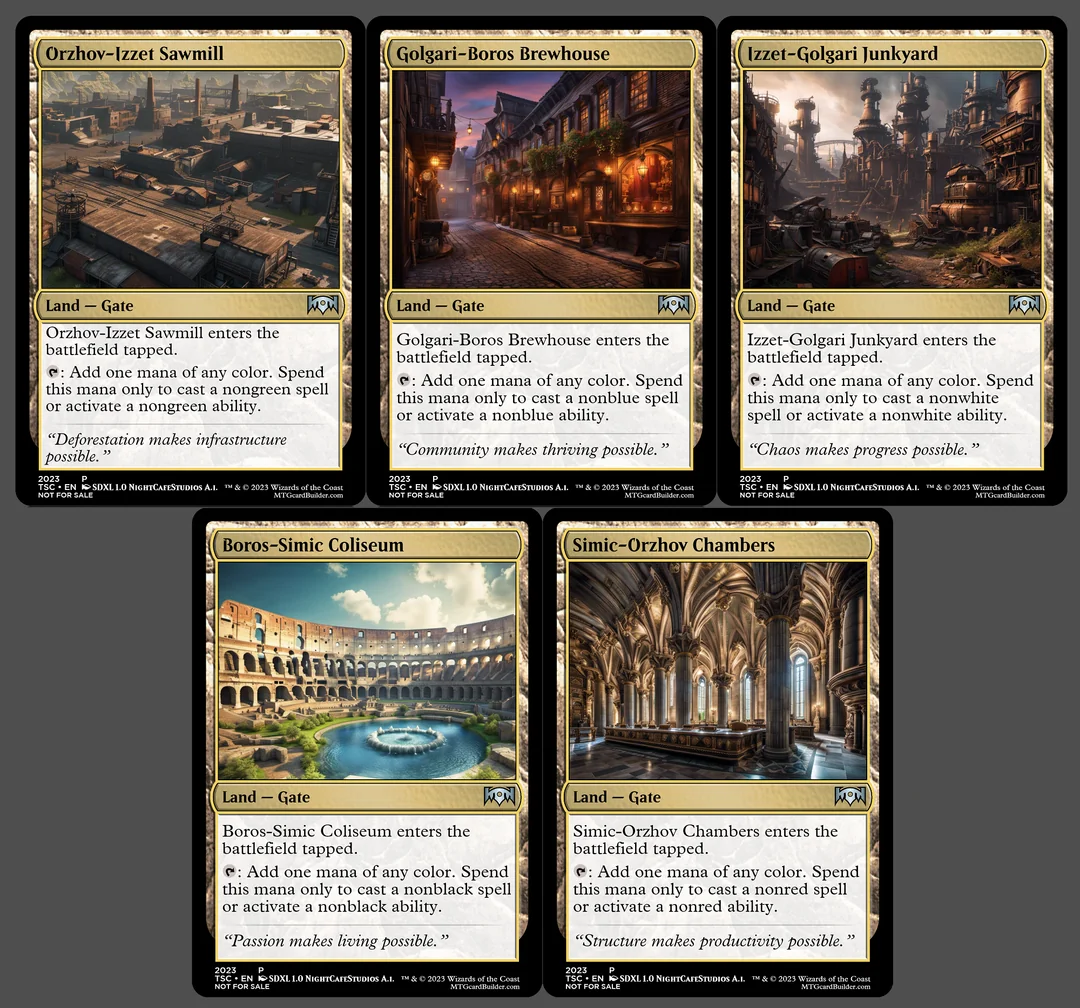
Image: A cycle of four-color lands by Reddit user TerryTags.
Shared and separate zones
Players share the library and the absolutely-removed-from-the-freaking-game-forever (ARFTFGF) zone. Every other zone, including each graveyard and exile, belongs to one player as usual.
Sharing a library leads to unusual milling and recursion strategies. That is fine unless it starts making the game less fun for the table.
Two clarifications about the ARFTFGF zone:
- Cards there are beyond “outside the game”. Cards such as Wish cannot retrieve them. (Mark Rosewater's answer)
- “Forever” lasts only until the current game ends. (Mark Rosewater's answer)
Tutors
Tutors are discouraged, not banned. They go against the “play what you find” spirit of the format, and above all they take far too long to resolve: the Pile is enormous, and in a Messy Pile nobody knows every card in it.
A total ban would also remove funny cards such as Booster Tutor, which do not have that problem. Before adding any tutor, ask whether it will really add to the fun.
For cards such as Tempest Hawk, a group could set aside a separate stack of fetchable copies. No formal rule exists for this; talk to your group.
Sleeves
In a Messy Pile, every player sleeves their own cards in their own distinct sleeves, so ownership is easy to sort out after the game. Do not re-sleeve everything in one shared style, and do not play unsleeved to hide whose card is whose.
Distinct sleeves sometimes tell opponents something about a hand. That is a consequence of the format and rarely affects the fun.
Choosing commanders
Option 1: let the Pile decide
Before the game, each player reveals cards from the top of the Pile until they reveal a creature. That creature becomes their commander and moves to the command zone. The group may restrict this to the first legendary creature revealed, or add any other restriction it likes.
The revealed creature will probably not match the color identity of the whole Pile. That requirement is ignored in this format.
Option 2: bring your own
Each player brings a five-color legendary creature to be their commander. It is separate from any cards they contribute to a Messy Pile.
Avoid commanders with tutor-like effects. In a Messy Pile they let a player lean on their own contributions instead of playing into the unpredictable card pool.
Option 3: deal them out
Each player brings three legendary creatures that could serve as a commander, ignoring color identity. Shuffle all of them together and deal three to each player. Each player picks the one they like best or think they can use best. The leftover candidates either stay out of the game or are shuffled into the Pile.
Which commanders work well
Commanders that generically improve other cards, grow on their own, or turn mana and spells into value work well: whatever the Pile provides, they can use it.
Typal (“tribal”) commanders work badly unless the Pile is themed around that creature type, because you cannot count on finding the right creatures. Commanders that tutor or search for a category of card slow the game down a great deal and can fail for the same reason.
| Commander | Verdict | Why |
|---|---|---|
| The Ur-Dragon | Bad | Typal |
| Jodah, the Unifier | Bad | Searches |
| Tiamat | Bad | A typal search |
| Kenrith, the Returned King | Good | Generically good effects; value from mana |
| Omnath, Locus of All | Good | Value from mana |
| Ramos, Dragon Engine | Good | Grows on its own; makes mana |
| Jodah, Archmage Eternal | Good | Generic cost reduction for spells |
Open questions
- Every open question in ordinary Pile o’ Magic applies here too: ownership of shared-library cards, players leaving, simultaneous draws, mulligans, Heap Land timing, and the four-color option.
- When the Pile decides commanders (option 1), where do the revealed cards that did not become a commander go: back on top, to the bottom, or shuffled in? Decide before selecting commanders.
Sources
- Pile o’ Magic Commander is our own format, recorded here first-hand; it has no outside source.
- It builds on Pile o’ Magic.